
Rub out or remove

When we make a mistake while writing or drawing, we often need a way to correct it. This action involves taking away marks, lines, or letters that we no longer want to keep on the page. It can be done with a pencil eraser, a special correction fluid, or even digitally on a computer screen. The goal of this process is to remove something completely so that it no longer appears. The word that means “rub out or remove” is erase.
The word “erase” is a common English verb that means to remove something completely, especially by rubbing, deleting, or wiping it away. It is often used when referring to removing writing, drawings, or recorded data. The term comes from the Latin word erasus, which is the past participle of eradere, meaning “to scrape out.” This origin helps us understand that erasing was originally a physical act—scraping ink or pencil marks off a surface to make it clean again. Over time, the meaning has expanded to include digital and abstract forms of removal as well.
In everyday life, the word erase appears frequently in classrooms, offices, and homes. For example, when a student makes an error on their homework, they might use a pencil eraser to erase the wrong answer and write the correct one. Teachers often erase the board after finishing a lesson so that they can start a new topic. In offices, someone might erase a meeting from the calendar when it is canceled. Even on computers and phones, people erase data, files, or text messages. In each of these cases, erase signifies the act of removing something completely.
From a grammatical perspective, erase is a regular verb. This means that in the past tense and past participle forms, it simply takes “-d” or “-ed” at the end.
- Present: erase
- Past: erased
- Past participle: erased
For example: - I erase the mistakes on my paper.
- She erased the wrong answer.
- They have erased all the data.
The noun form of the word is erasure, which means the act of removing or deleting something. For instance: The erasure of old traditions can change a culture over time. The related adjective is erasable, meaning “able to be erased.” For example: Use erasable pens so you can correct mistakes easily.
In the digital age, the word erase has taken on new meanings. It is not just about rubbing out pencil marks anymore. On computers, to erase means to delete information permanently. For example, when you erase a file from your hard drive, you remove it from storage so it cannot be easily recovered. Similarly, when someone says they erased their history on a browser, it means they deleted their record of visited websites. This shows how language evolves with technology—what once described a physical action now applies to data and memory as well.
In literature and psychology, erase carries symbolic meaning. To erase something can represent forgetting, denial, or emotional cleansing. For example, a character in a novel might wish to erase painful memories of the past. This doesn’t mean physically removing words or images but symbolically wiping away something from the mind or heart. The metaphorical use of erase adds depth to the language, showing how words can express both literal and emotional actions.
The word erase is often compared with other verbs that mean “to remove” or “to delete,” but each has slightly different nuances:
- Erase: usually means to remove writing, marks, or recorded data.
Example: I erased the drawing from the board. - Delete: more technical, often used with digital files or text.
Example: She deleted the email. - Wipe: implies physically cleaning a surface.
Example: Wipe the board before writing again. - Remove: more general, can refer to taking away anything.
Example: Please remove your shoes before entering.
So while all these words involve taking something away, erase has a more specific focus on clearing marks or data to restore a clean state.
From a pronunciation standpoint, the word erase is pronounced /ɪˈreɪs/. The stress falls on the second syllable “race.” It rhymes with words like face and place. The noun form erasure is pronounced /ɪˈreɪʒər/ in American English or /ɪˈreɪʒə/ in British English. Learners of English often find it useful to remember that the “s” in erase sounds like a “z” because of the voiced sound before it.
In idiomatic and figurative expressions, erase appears in a few interesting ways. For example:
- “Erase the past” means to forget or move on from previous experiences.
- “Erase the line” can mean to remove boundaries or differences.
- “Erase from memory” suggests trying to forget something unpleasant.
These figurative uses extend the meaning of erase beyond simple removal to emotional or psychological contexts.
From a technological and scientific viewpoint, erasing has a very specific role. In electronics, for example, magnetic tapes, floppy disks, and modern flash drives can be erased—that is, their stored information can be reset or wiped clean. The term “data erasure” refers to methods of securely removing data so that it cannot be recovered later. This is important for privacy and security, particularly in information technology. Companies often perform secure erasure when disposing of old computers to protect sensitive data.
In education, the concept of erasing teaches children the value of correction and revision. The ability to erase mistakes gives learners confidence to try again without fear of failure. In this sense, the eraser becomes a symbol of growth and learning. It reminds students that errors are a natural part of progress and can be fixed. Teachers often say, “Don’t be afraid to make mistakes—you can always erase and try again.” Thus, erase embodies a positive and forgiving approach to learning.
Culturally, the word erase can also have heavier implications. The term erasure is used in social discussions to describe the removal or ignoring of certain identities, histories, or voices. For example, cultural erasure refers to the loss of traditions due to colonization or modernization. Identity erasure can describe the way certain groups are overlooked or misrepresented. These uses show how the concept of “erasing” extends from physical to social and political contexts, carrying powerful meanings about memory, recognition, and justice.
To summarize, erase is a versatile and meaningful word that began as a physical action—scraping ink or pencil marks from a surface—but has evolved to describe digital, emotional, and cultural forms of removal as well. Whether it’s cleaning a blackboard, deleting a file, or letting go of a painful memory, the act of erasing represents the human desire for renewal and clarity. Therefore, when we read the phrase “rub out or remove,” the correct answer is Erase.

Benzer Konular

Informationen zur Person 1Okunuşu: informatsiyonen tsur person aynTürkçesi: Çözüm Kişiyle İlgili Bilgiler 1 5. Was passt? Ergänzen Sie!Okunuşu: Vas passt Ergentsın ziTürkçesi: Hangisi uyar? Tamamlayın. Wie | Woher | Spricht … | Kommt … | Ist … | Wer | Wo | Sind …Okunuşu: Vi | Vohıır | Şpriht |...

Kutu Kutu Pense: Öğrenciler gruplara ayrılır ve el ele tutuşarak daire olurlar. Dönerek aşağıdaki tekerlemeyi söylerler: Kutu kutu pense,Elmamı yerse,Arkadaşım -bir isim,Arkasını dönse. Adı söylenen öğrenci arkasını döner. Sırayla herkes arkasını döndükten sonra aynı tekerlemeyle önlerine dönerler. Aç Kapıyı Bezirgân Başı: Sınıftan iki öğrenci seçilir. Bu öğrenciler aralarında anlaşarak her...

Een grasveld waarin lammetjes lopen, roept meteen het beeld op van een open, groene plek waar jonge dieren veilig kunnen grazen, bewegen en dicht bij de kudde blijven. In zo’n omschrijving gaat het niet zomaar om een stuk natuur of een willekeurig veld, maar om een plek die hoort bij...

Geometrik şekillerin yönlerini değiştirdiğimizde biçimsel özellikleri değişir mi? Neden? Kısa Cevap:Geometrik şekillerin yönlerini değiştirdiğimizde biçimsel özellikleri değişmez. Çünkü yön değiştirme sadece şeklin uzaydaki konumunu değiştirir, kenar uzunluğu, açı ölçüsü, kenar sayısı gibi biçimsel özelliklerini etkilemez. Geometrik şekiller, matematiğin en temel konularından biridir. Kare, üçgen, dikdörtgen, daire, beşgen gibi iki boyutlu...
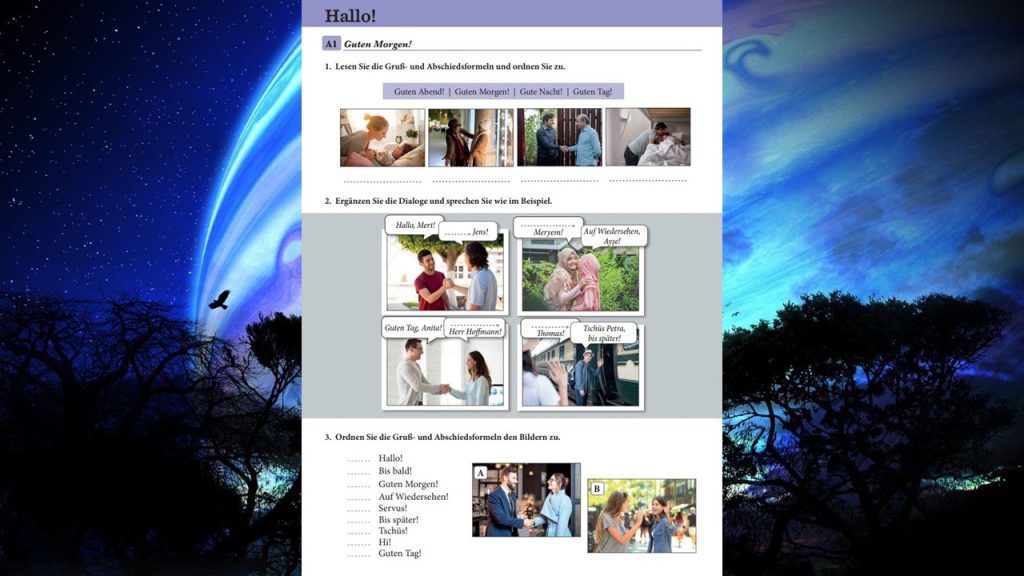
Hallo! (merhaba)A1- Guten Morgen! (Günaydın!) 1. Lesen Sie die Gruß- und Abschiedsformeln und ordnen Sie zu. (Selamlama ve veda ifadelerini okuyun ve eşleştirin.) Sırasıyla ilk fotoğraftan başlayarak;Guten Morgen! (1. fotoğraf)Guten Abend! (2. fotoğraf)Guten Tag! (3. fotoğraf)Gute Nacht! (4. fotoğraf) 2. Ergänzen Sie die Dialoge und sprechen Sie wie im Beispiel. (Diyalogları...

Meslekleri ve görevlerini eşleştir. DOKTOR: Muayene eder, tedaviniz için gerektiğinde ilaç yazarım.HEMŞİRE: Hastaların tedavisinde doktorlara yardımcı olurum.DİŞ HEKİMİ: Ağız ve diş sağlığınızla ilgilenirim.ECZACI: Doktorun verdiği reçetedeki ilaçları benden alırsınız. Doktor Hemşire Diş Hekimi Eczacı
Bir Yorum Yazın
Ziyaretçi Yorumları - 0 Yorum